Launch offer — valid today only

📄 Digital book in PDF · read it on your phone or print it

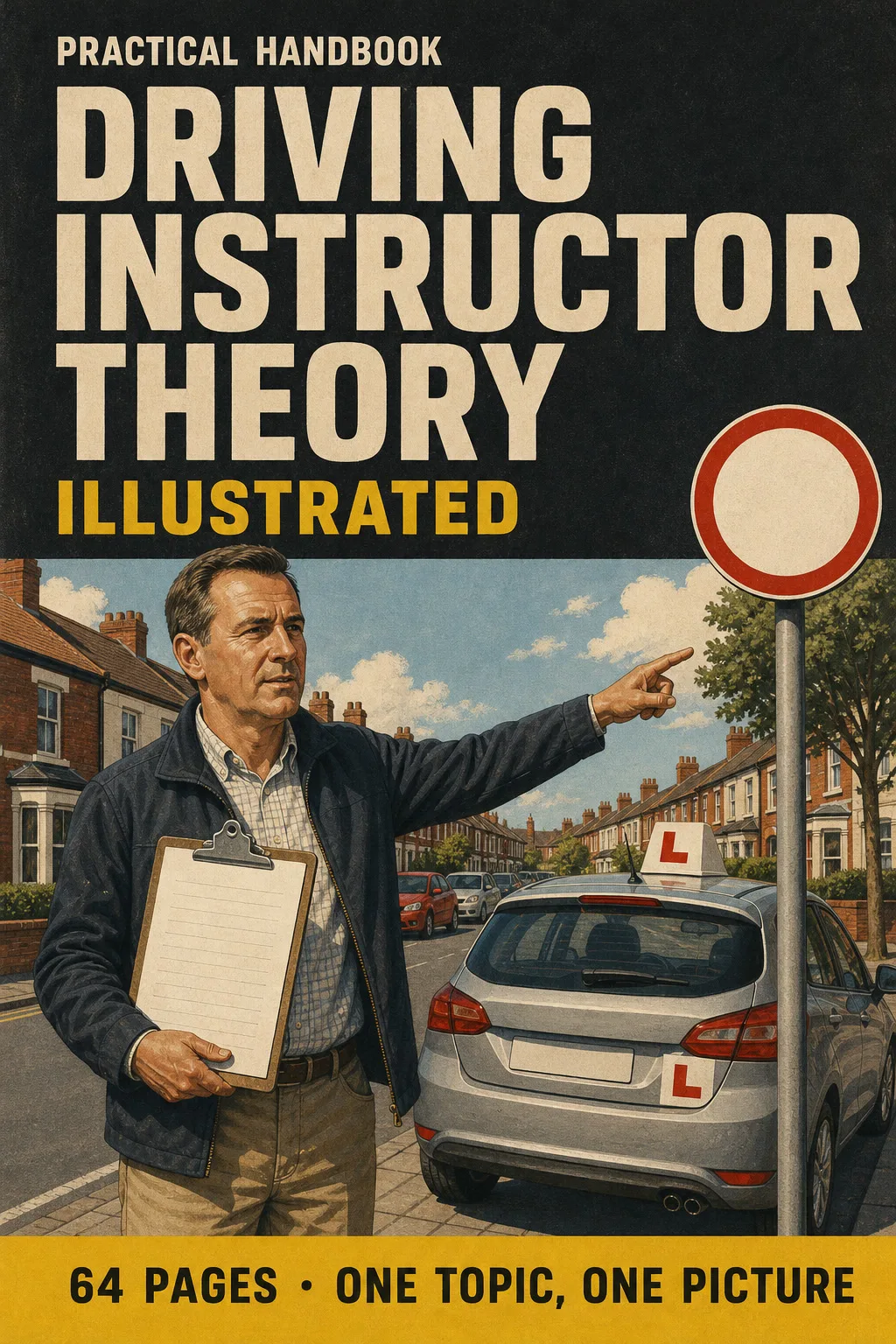
The ADI Part 1 Theory Test in Drawings Every Band, Routine and Pass Mark on Its Own Page

Road procedure, sign shapes, stopping distances, speed limits, the law, the learner's test, coaching and hazard perception. Every topic has its own page: the drawing first, then what you need to remember. 64 illustrated pages.

START STUDYING THIS WAY

🔒 Secure checkout · PDF by email · 30-day guarantee
Every topic, its own pageEach rule drawn, with the explanation right beside it
64 illustrated pages7 parts, from the Part 1 map to test day
Up-to-date sourcesHighway Code, Know Your Traffic Signs and GOV.UK guidance
PDF by emailFormat

Look Inside the Book

Every page has one big drawing and a box with the numbers, rules and steps you need to know:

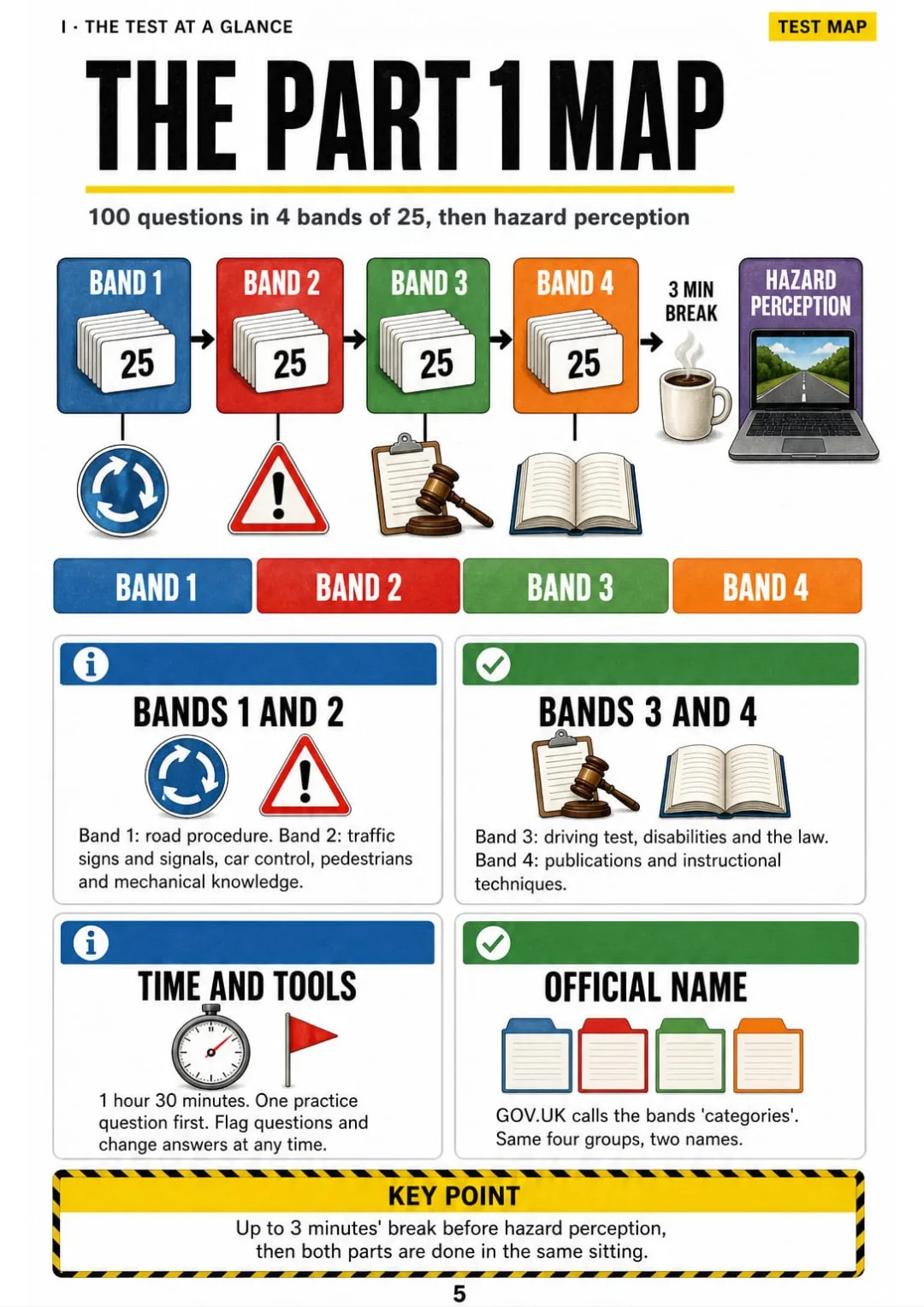
100 questions, 4 bands of 25, 1 hour 30 minutes, then hazard perception
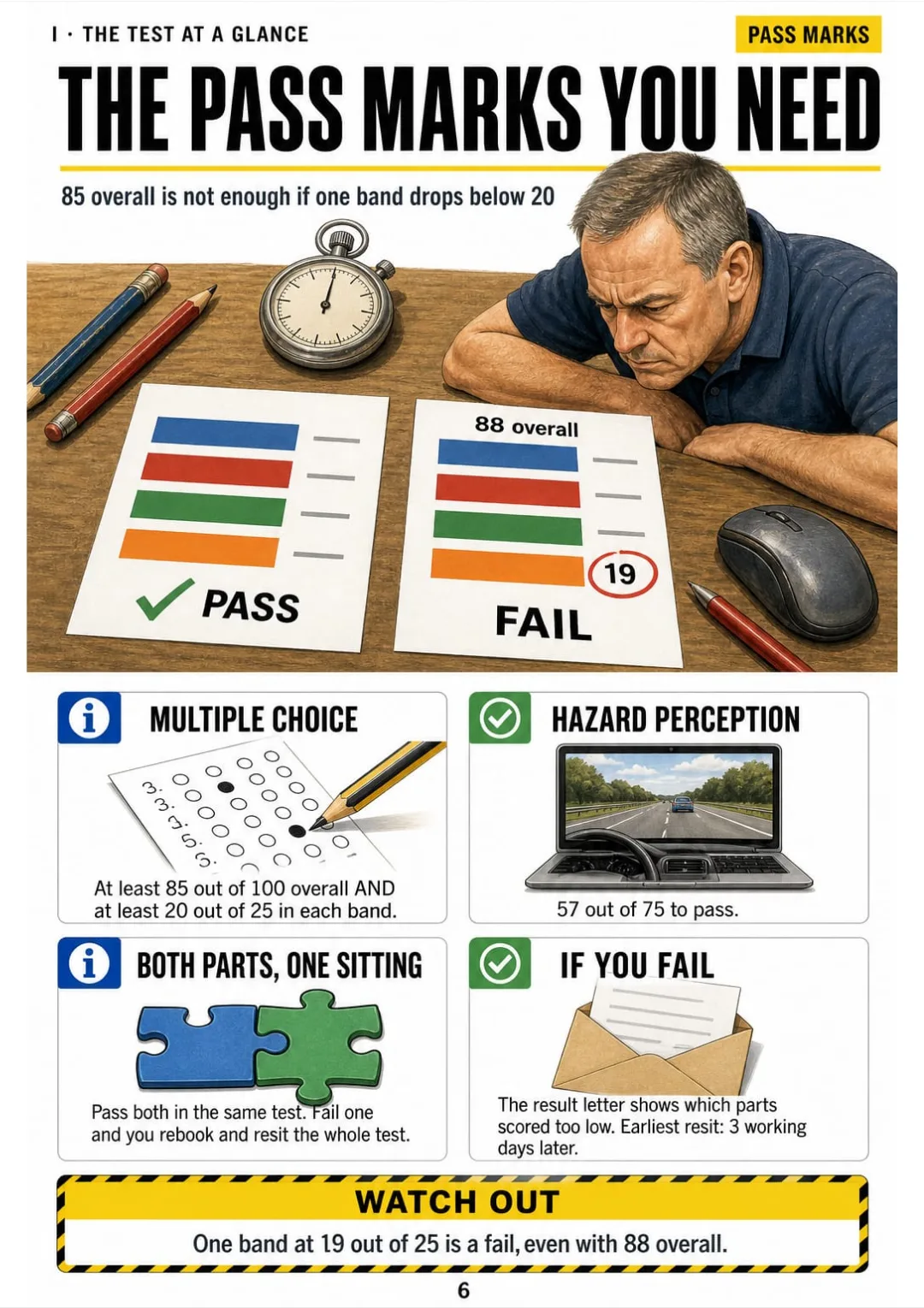
85/100 overall, 20/25 in every band and 57/75 in hazard perception, same sitting
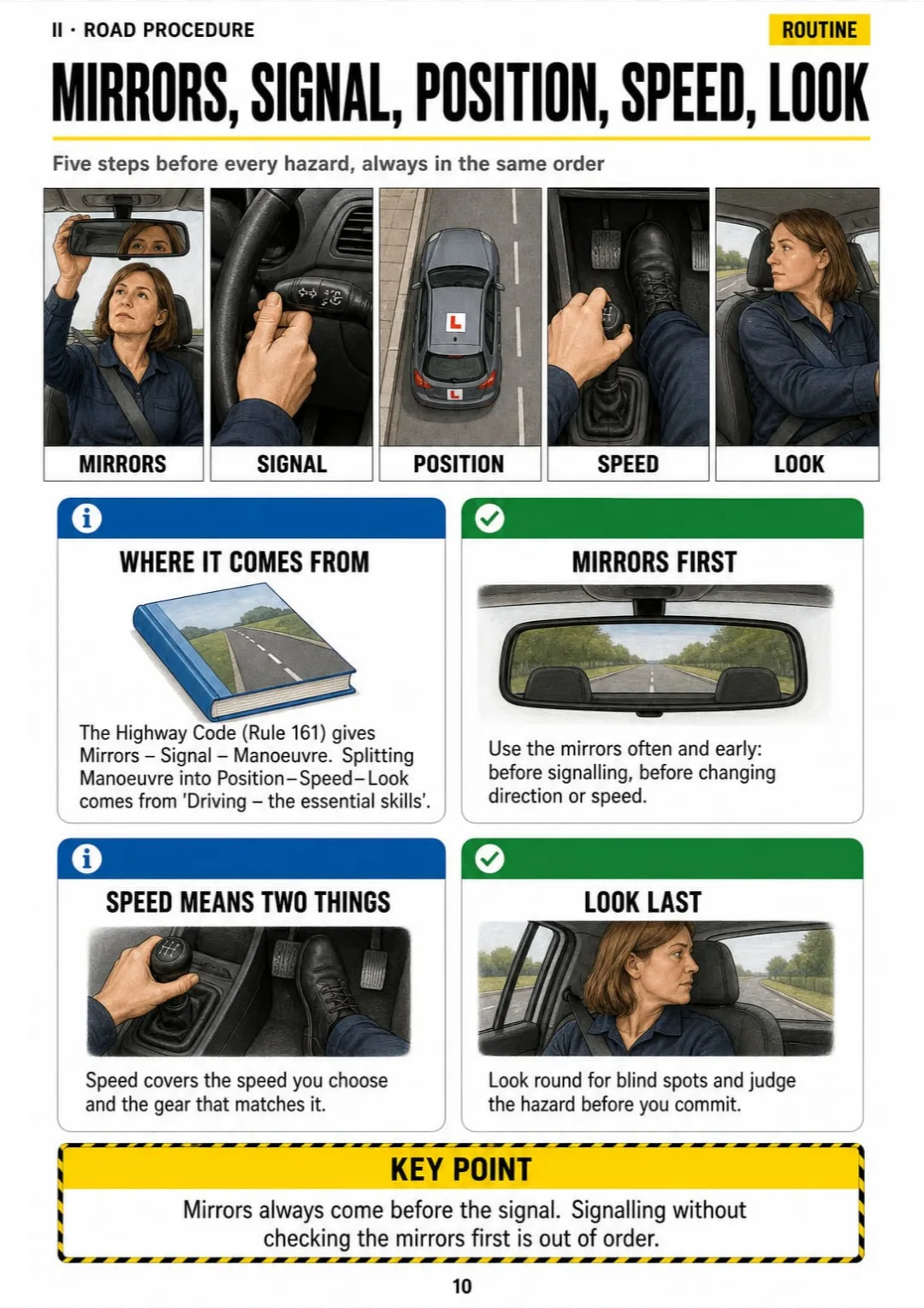
MSPSL: Mirrors, Signal, Position, Speed, Look – five steps, one fixed order
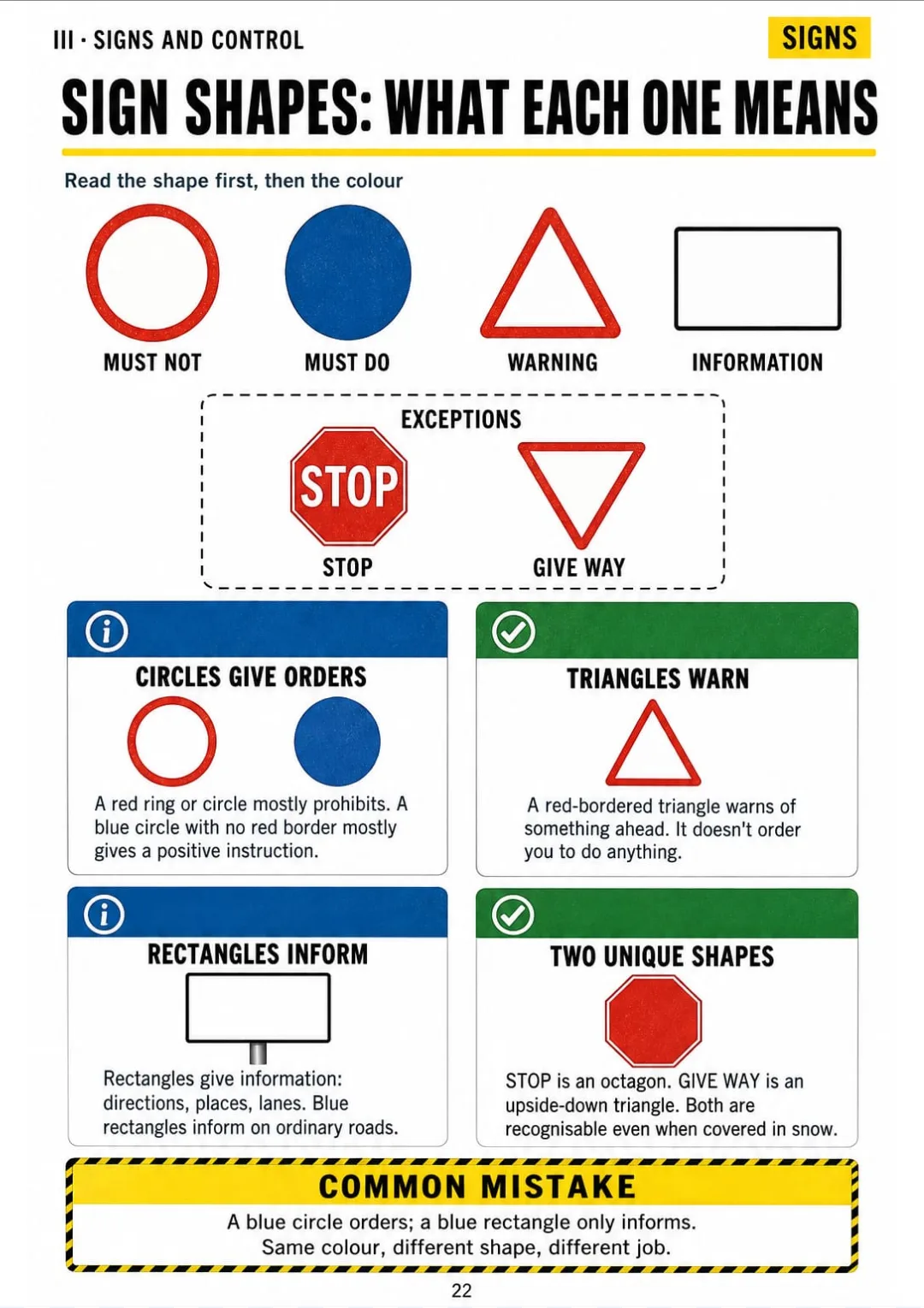
Red circles mostly prohibit, blue circles mostly instruct, STOP is an octagon, Give Way is upside down.
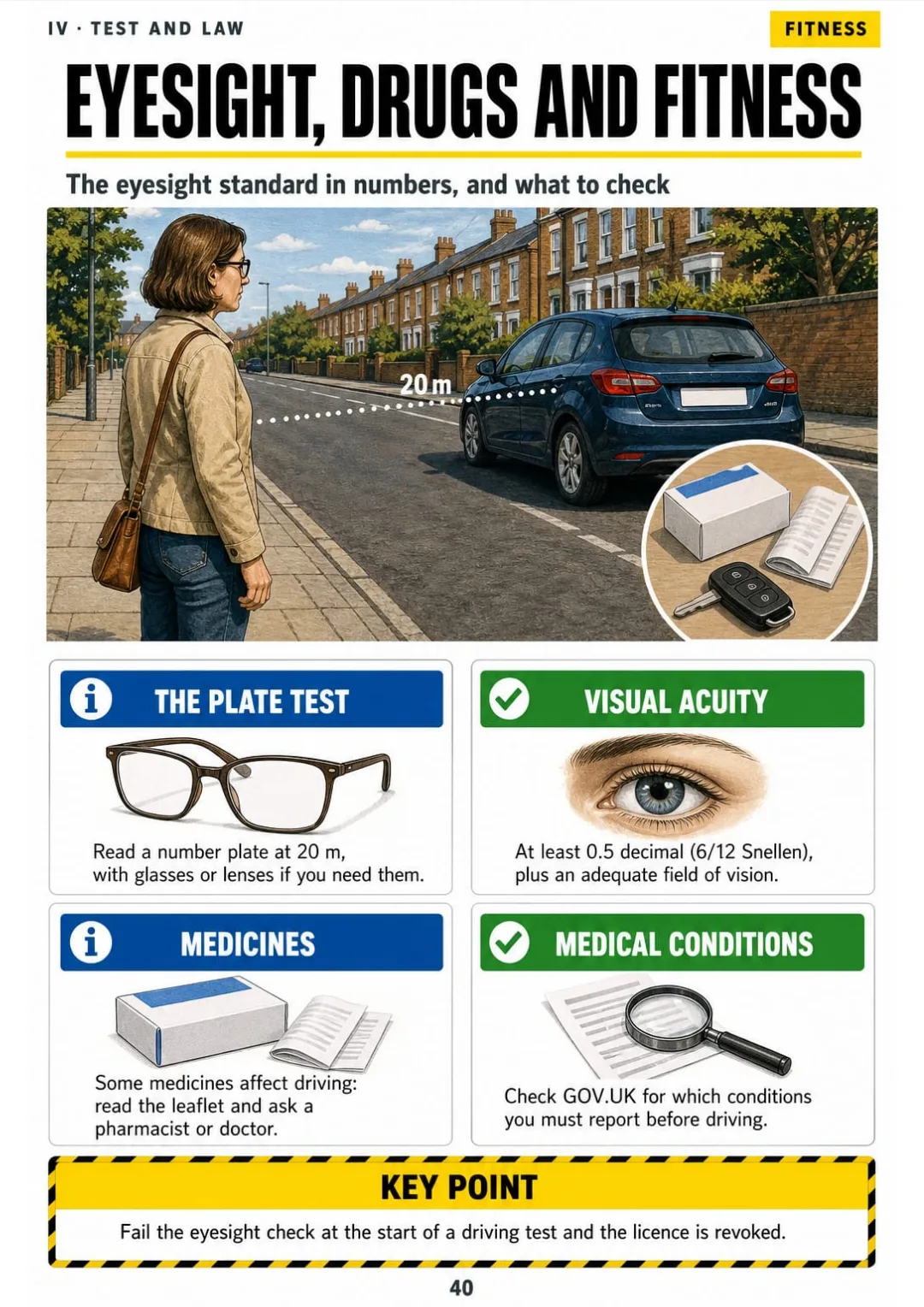
Eyesight standard: number plate at 20 m and at least 6/12 Snellen
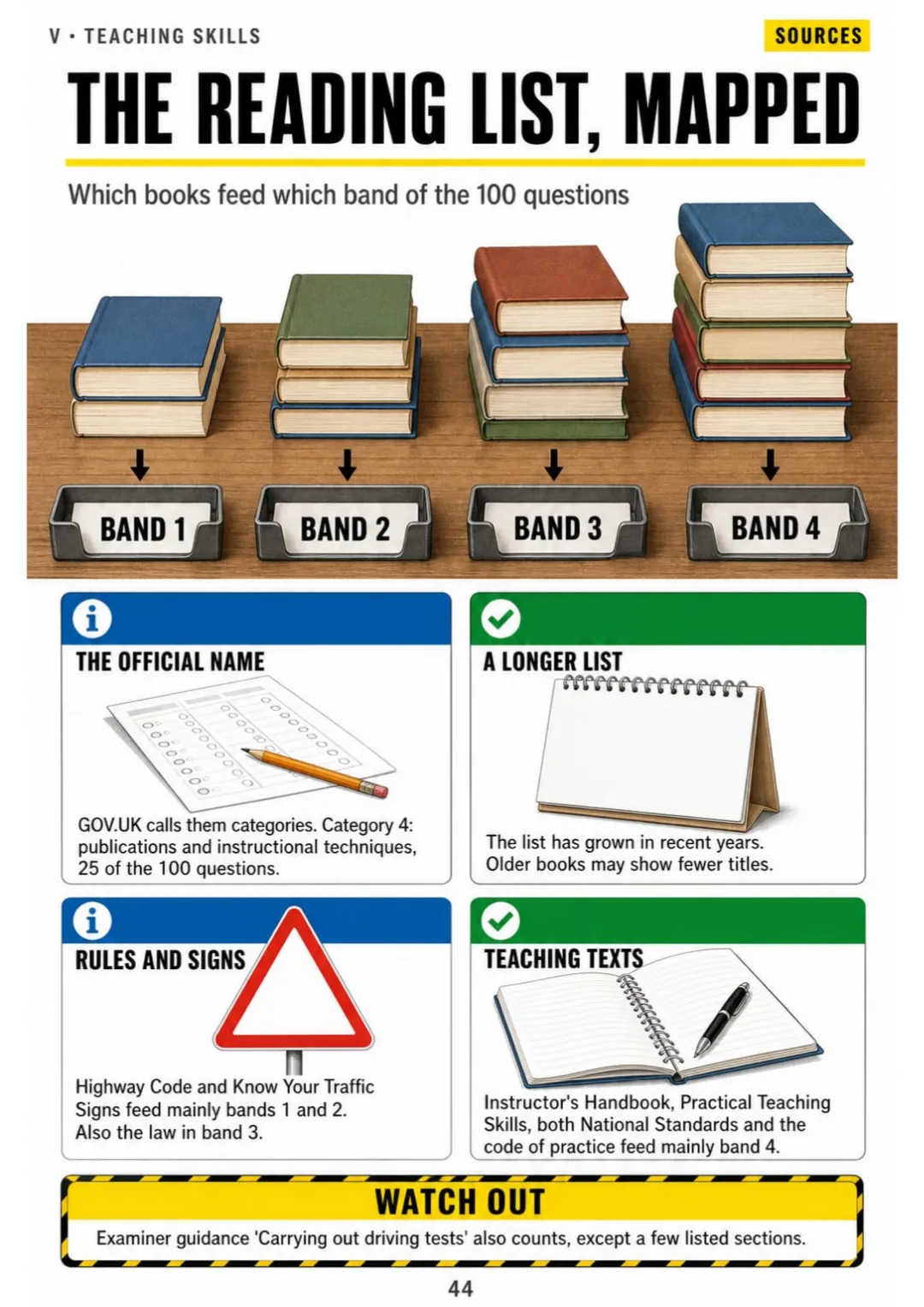
Since 1 August 2025, Part 1 questions draw on 10 titles, not 3 to 6.
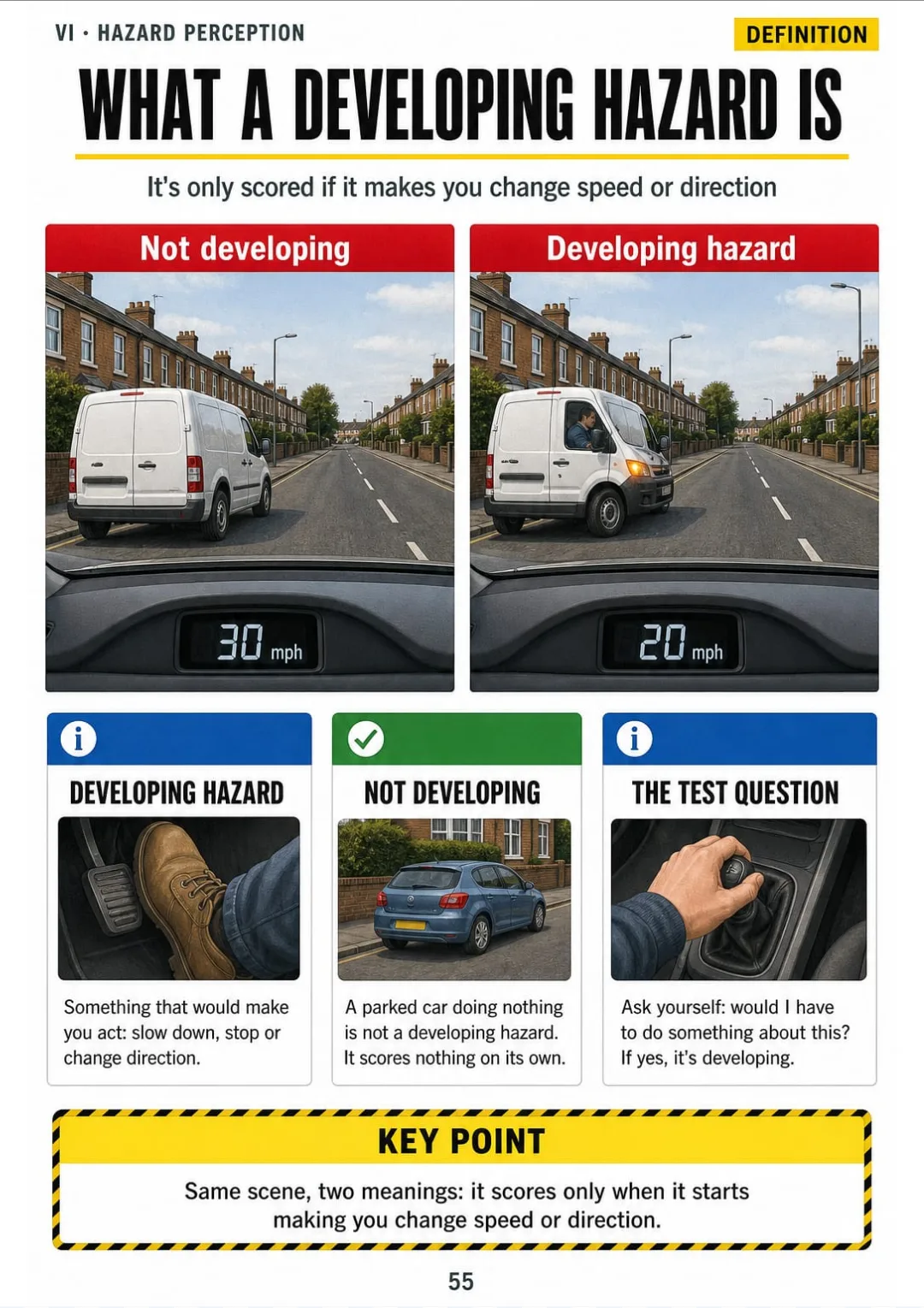
Developing hazard = something that would make you change speed or direction. A parked car doing nothing isn't one.
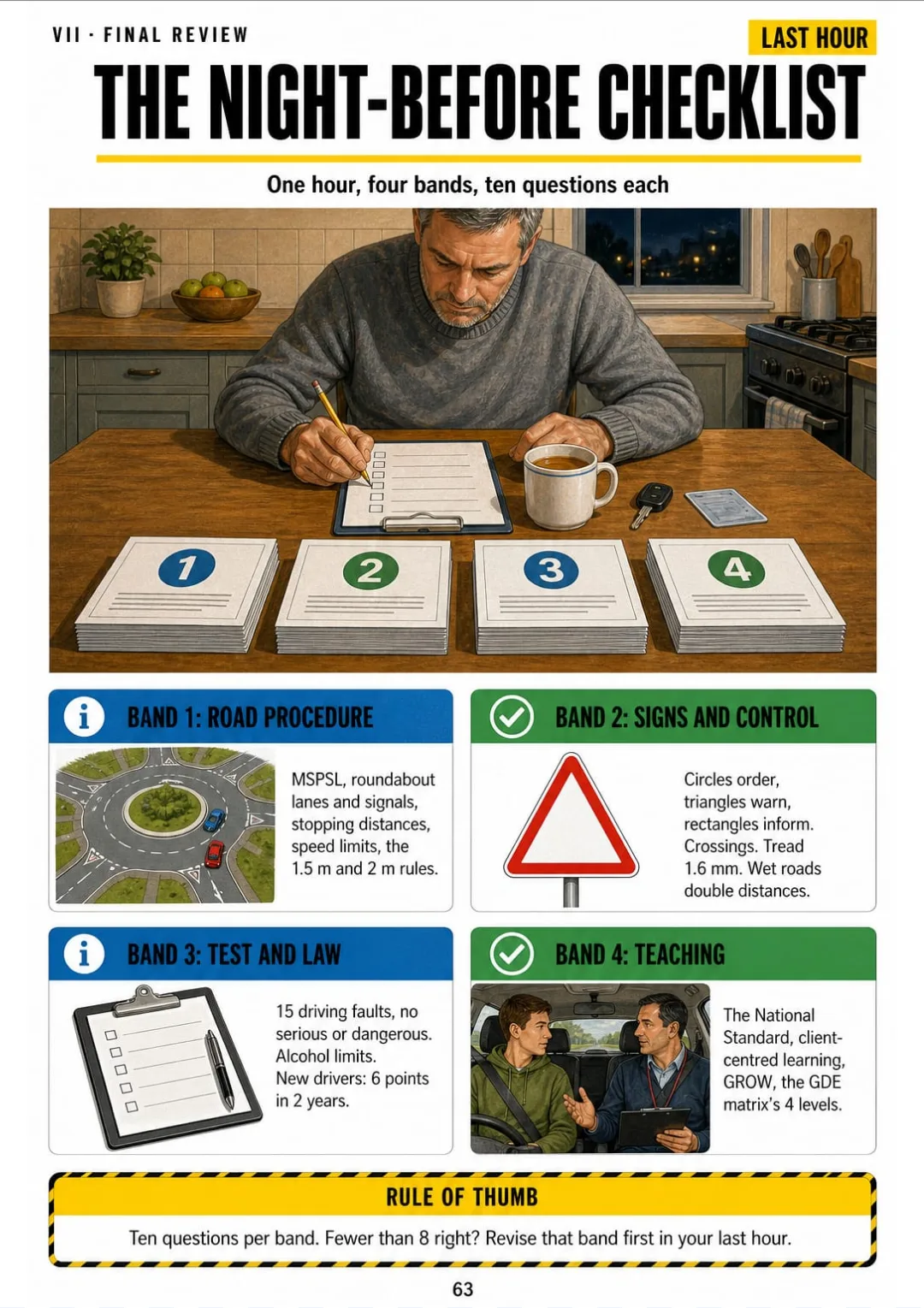
Your last hour, band by band, with a 10-question self-test for each

Swipe to see more →

These are real pages from the book. The table of contents is the full one: 7 parts and 60 topics.

The Problem Isn't You. It's How It Was Explained to You.

You're out with your trainer, coming up to a right turn, and he asks you to talk him through it. You've done it for thirty years, but the words won't come out in order.

The routine is in the book. But there it's a paragraph: mirrors, then signal, then position, with exceptions in between. Read as text, five steps blur into one long sentence.

MSPSL: Mirrors, Signal, Position, Speed, Look – five steps, one fixed order

Here, Mirrors, Signal, Position, Speed, Look is one page: the car drawn at the junction, each step numbered on the road, and a box showing which mirror to check and when.

Same with stopping distances, sign shapes, the pass marks, the learner's practical test and what counts as a developing hazard: each one has its own page.

You see the order, so you say it in order, and you don't go back to the manual to check.

COMPARE FOR YOURSELF

The Same Topic, Two Ways to Study It

THIS
  • The manual: line after line
  • Pass marks explained only in words
  • You get to the test still unsure
Candidates should note that the multiple-choice element of the Part 1 theory test comprises 100 questions, divided into four bands of 25 questions each, namely road procedure; traffic signs and signals, car control, pedestrians and mechanical knowledge; driving test, disabilities and the law; and publications and instructional techniques. In order to pass, a candidate must achieve an overall score of at least 85, together with a minimum of 20 in each band, and must additionally achieve 57 out of 75 in the hazard perception element at the same sitting.
FOR THIS
  • The pass marks in one drawing
  • The numbers in one box
  • You see it and you get it
85/100 overall, 20/25 in every band and 57/75 in hazard perception, same sitting
CONTENTS

Take a Look at the 7 Parts and 60 Topics

The test at a glance, road procedure, signs and car control, the test and the law, teaching techniques, hazard perception and a final review: 64 pages, all illustrated.

IThe test at a glance · pp. 5-9
  1. The Part 1 map: 4 bands plus hazard perception
  2. The pass marks you need
  3. Where Part 1 fits on the road to ADI
  4. How to read a page in this book
  5. A revision rhythm, one band at a time
IIRoad procedure · pp. 10-21
  1. Mirrors, Signal, Position, Speed, Look
  2. Prepare, Observe, Manoeuvre
  3. When to check the mirrors
  4. Signals: helpful, timely, never misleading
  5. Positioning at junctions
  6. Roundabouts: lane, signal, exit
  7. Stopping distances in the dry
  8. The two-second rule and bad weather
  9. Speed limits by road and vehicle
  10. Overtaking: when not to
  11. Motorways: joining, lanes and signals
  12. The hierarchy of road users
IIISigns, control and pedestrians · pp. 22-33
  1. Sign shapes: circles, triangles, rectangles
  2. Direction sign colours
  3. Road markings along and across the road
  4. Traffic lights, filters and authorised signals
  5. Pedestrian crossings, side by side
  6. Vulnerable road users
  7. The car controls and dual controls
  8. Skids and ABS
  9. Rain, fog and aquaplaning
  10. Tyres: tread and pressure
  11. Warning lights and fluid checks
  12. Eco-safe driving
IVThe test, disabilities and the law · pp. 34-43
  1. The learner's practical test, step by step
  2. Driving, serious and dangerous faults
  3. The learner's theory test
  4. Teaching learners with a disability
  5. Provisional licence and supervising a learner
  6. Alcohol limits: England, Wales and NI vs Scotland
  7. Drugs, eyesight and fitness to drive
  8. Documents: licence, insurance, MOT and tax
  9. Penalty points and new drivers
  10. The instructor's legal side
VPublications and instructional techniques · pp. 44-54
  1. The recommended reading list, mapped
  2. The National Standard for driver training
  3. Client-centred learning
  4. Coaching: questions that make the learner think
  5. The GROW model
  6. The experiential learning cycle
  7. Learning styles
  8. The structure of a lesson
  9. Risk management on a lesson
  10. Feedback and reflection
  11. The Goals for Driver Education matrix
VIHazard perception · pp. 55-59
  1. What a developing hazard is
  2. The scoring window: 5 points down to 0
  3. The clicking trap
  4. 14 clips, 15 hazards, 57 to pass
  5. Early clues by type of road
VIIFinal review · pp. 60-64
  1. All the numbers on one page
  2. All the routines in order
  3. Mix-ups that come up often
  4. The night-before checklist
  5. Test day

One Page, One Topic, All Clear

Think of it this way:

It's the evening before your Part 1. You want to check, one last time, how many marks you need in each band and how many in hazard perception.

You open the book at the pass marks page and see the four bands drawn as four boxes, each with its 20 out of 25, and hazard perception beside them with 57 out of 75.

Eyesight standard: number plate at 20 m and at least 6/12 Snellen

Same with MSPSL, sign shapes, stopping distances, the learner's practical test and the GROW model: each one on its own page.

Driving Instructor Theory Illustrated is 7 parts and 60 topics, all drawn, and it ends with a final review: all the numbers on one page, all the routines in order and the mix-ups that come up often.

What you see drawn, you don't have to memorize.

What's Inside Driving Instructor Theory Illustrated:

Ipp. 5-9

The test at a glance

The Part 1 map with its 4 bands and hazard perception, the pass marks, where Part 1 fits on the road to ADI and a revision rhythm one band at a time.

IIpp. 10-21

Road procedure

MSPSL, POM, mirror checks, signals, junctions, roundabouts, stopping distances, the two-second rule, speed limits, overtaking, motorways and the hierarchy of road users.

IIIpp. 22-33

Signs, control and pedestrians

Sign shapes and colours, road markings, traffic lights, pedestrian crossings, vulnerable road users, dual controls, skids and ABS, bad weather, tyres, warning lights and eco-safe driving.

IVpp. 34-43

The test, disabilities and the law

The learner's practical and theory tests, driving, serious and dangerous faults, disabilities, supervising a learner, alcohol and drugs, documents, penalty points and the instructor's legal side.

Vpp. 44-54

Publications and instructional techniques

The reading list mapped, the National Standard, client-centred learning, coaching questions, GROW, the experiential learning cycle, lesson structure, risk management, feedback and the GDE matrix: the band that's new if you've only ever driven, drawn so you can explain it back.

VIpp. 55-59

Hazard perception

What a developing hazard is, the scoring window from 5 points down to 0, the clicking trap, the 14 clips and early clues by type of road.

VIIpp. 60-64

Final review

All the numbers on one page, all the routines in order, the mix-ups that come up often, the night-before checklist and test day.

At the end of the book: A final review with all the numbers on one page, all the routines in order and the mix-ups that come up often.

Plus: 2 Free Books

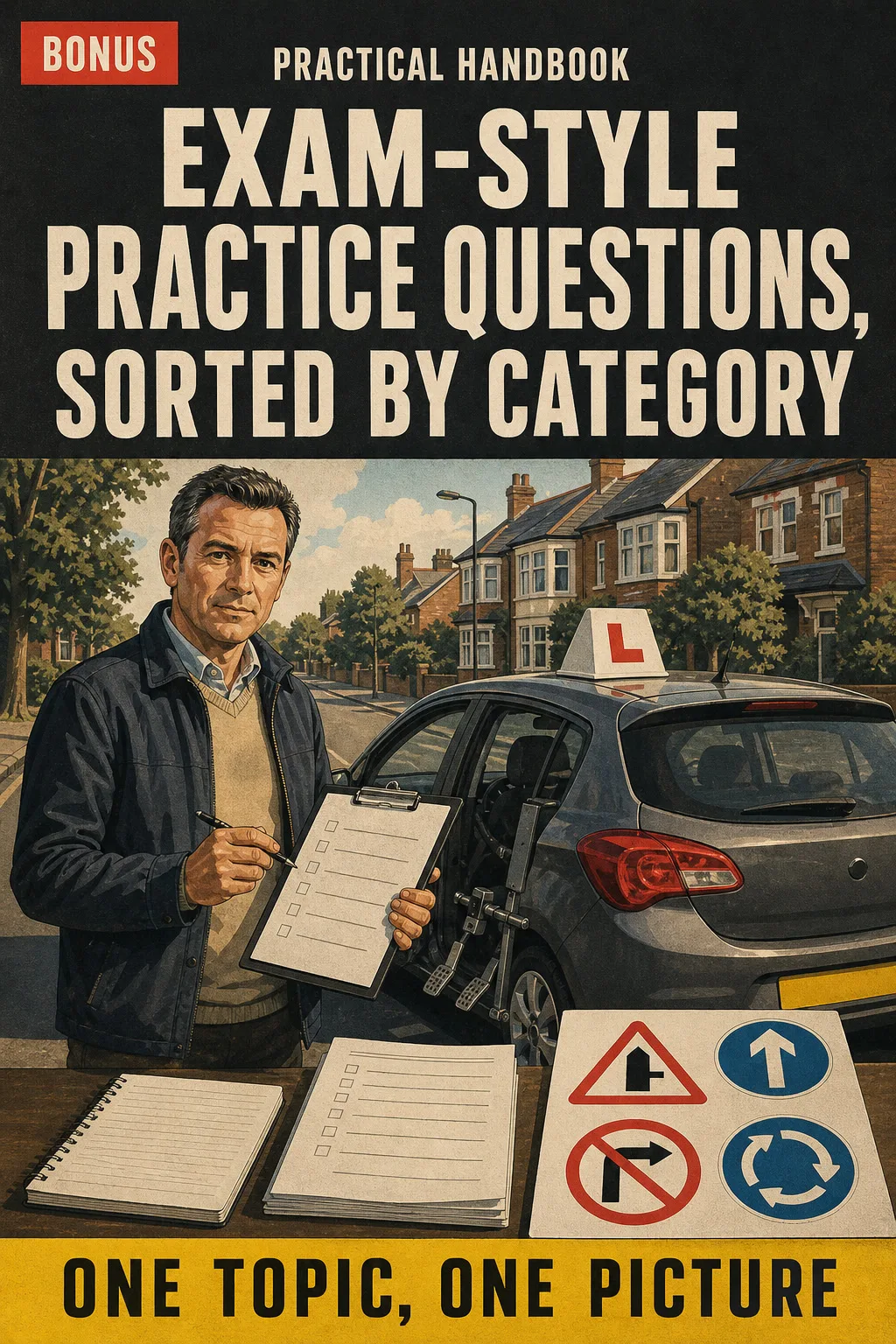
Exam-Style Practice Questions, Sorted by Category

BONUS 1: «Exam-Style Practice Questions, Sorted by Category»

Value on its own: US$ 17.90

Practise the multiple-choice part one category at a time, with every answer explained, so you can see exactly which of the four areas needs more work.

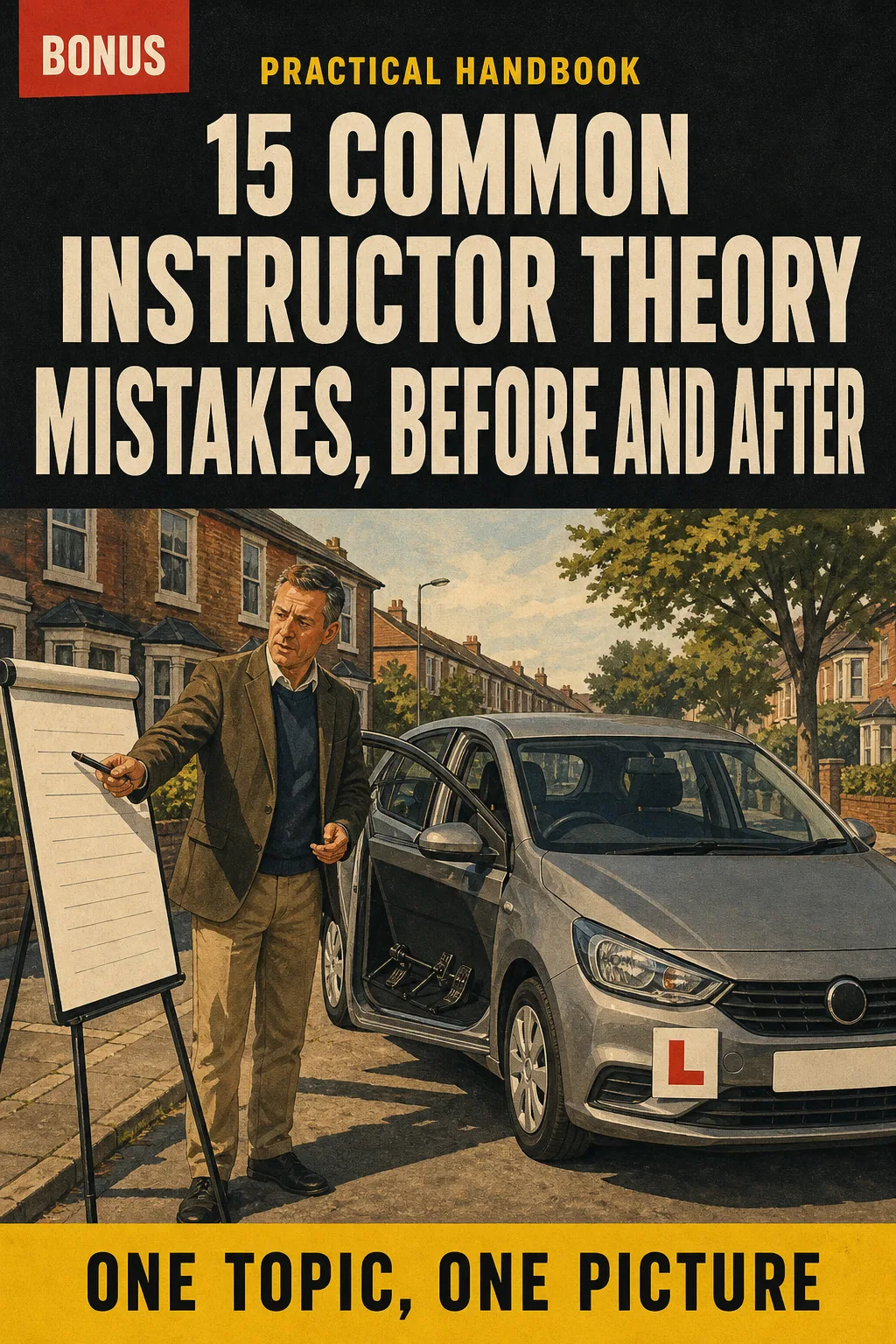
15 Common Instructor Theory Mistakes, Before and After

BONUS 2: «15 Common Instructor Theory Mistakes, Before and After»

Value on its own: US$ 14.90

The mix-ups that come up most often — stopping distances, sign shapes, who is responsible on a lesson — each one drawn wrong and right, ready to revise the night before.

Driving Instructor Theory Illustrated with 2 Free Books

  • Driving Instructor Theory Illustrated: 64 illustrated pagesUS$ 63
  • BONUS 1: Exam-Style Practice Questions, Sorted by CategoryUS$ 17.90
  • BONUS 2: 15 Common Instructor Theory Mistakes, Before and AfterUS$ 14.90
  • High-resolution PDF to printIncluded
Total value US$ 95.80
YOUR PRICE:
US$ 27
You save US$ 68.80
YES, I WANT DRIVING INSTRUCTOR THEORY ILLUSTRATED FOR US$ 27

📄 This is a digital PDF book sent to your email: nothing is printed or shipped.

Secure purchaseEncrypted payment30-day guarantee

PDF by email: We email you Driving Instructor Theory Illustrated as a PDF, together with the two free books. It's a single payment: no installments, no extra charges.

Who This Book Is For

You're starting ADI training

You're starting ADI training

You get the whole of Part 1 as a map before you dive in: four bands, hazard perception and a page for every topic, so you always know where you are.

Your Part 1 date is booked

Your Part 1 date is booked

You revise one band at a time and check the pass marks, the numbers and the routines at a glance, without rereading whole manuals.

You're already in the car with learners

You're already in the car with learners

You keep it to hand to explain MSPSL, sign shapes or a developing hazard the way you saw them drawn.

Everything You Get Today

US$ 95.80US$ 27
YES, I WANT DRIVING INSTRUCTOR THEORY ILLUSTRATED FOR US$ 27

📄 This is a digital PDF book sent to your email: nothing is printed or shipped.

30DAYS
GUARANTEE

30-Day Guarantee

Try Driving Instructor Theory Illustrated for 30 days, bonus books included.

We refund everything if the file won't open, if the book isn't what you see here, if you were charged twice or if the email doesn't arrive. Just email us.

You pay once. No subscriptions.

Frequently Asked Questions

Is it for me if I've been driving for decades but haven't studied in years?

Yes. It's for the approved driving instructor (ADI) Part 1 in Great Britain, not the learner's theory test. It starts with a map of the test and goes one topic per page, with the drawing first and the rule in a few short lines. No academic background needed.

Where does the content come from?

From the current editions of the Highway Code (including the 2022 changes, such as the hierarchy of road users), Know Your Traffic Signs, GOV.UK guidance on the ADI Part 1 theory test and the National Standard for Driver and Rider Training. Every number and rule is checked against them, including the current test format: 100 questions in 4 bands, then 14 hazard perception clips.

Is it official material?

No. It's an independent illustrated study book. It names the DVSA and the Highway Code only to say what the test covers, and it isn't affiliated with or endorsed by the DVSA. It doesn't give you a certificate or count towards your ADI qualification: it helps you revise for Part 1.

I already have the recommended books and a question app. What does this add?

The app tells you when you get a question wrong, and the books explain it in paragraphs. This puts each topic on one page, drawn, with the numbers, rules and steps in one box, so you can revise one band in an evening and check a rule at a glance. It doesn't replace your ADI training, your trainer or the recommended publications: it sits beside them.

Are the practice questions the ones in the test?

No. They're written for this book, in the style of the test and sorted by band. They aren't official questions and they don't come from the DVSA's revision question bank.

How does it arrive?

As a PDF by email, to the address you enter when you pay. The 2 free books come with it.

Do I have to pay every month?

No. It's a one-off payment. No subscription.

Can I have it on paper?

Yes. The PDF is made to print at home or at a print shop, so you can study at the table and write on it.

How does the refund work?

You have 30 days. We refund everything if the file won't open, if the book isn't what you see on this page, if you were charged twice or if the email doesn't arrive: just email us.

Before You Close This Page

No more rereading with nothing sticking.

MSPSL, the pass marks and the sign shapes: you see them drawn, and that's it.

You get to Part 1 knowing where everything is.

Drawings make studying faster.

The book is right below.

One-time payment: US$ 27 · Guarantee: 30 days · PDF by email

YES, I WANT DRIVING INSTRUCTOR THEORY ILLUSTRATED FOR US$ 27

📄 This is a digital PDF book sent to your email: nothing is printed or shipped.